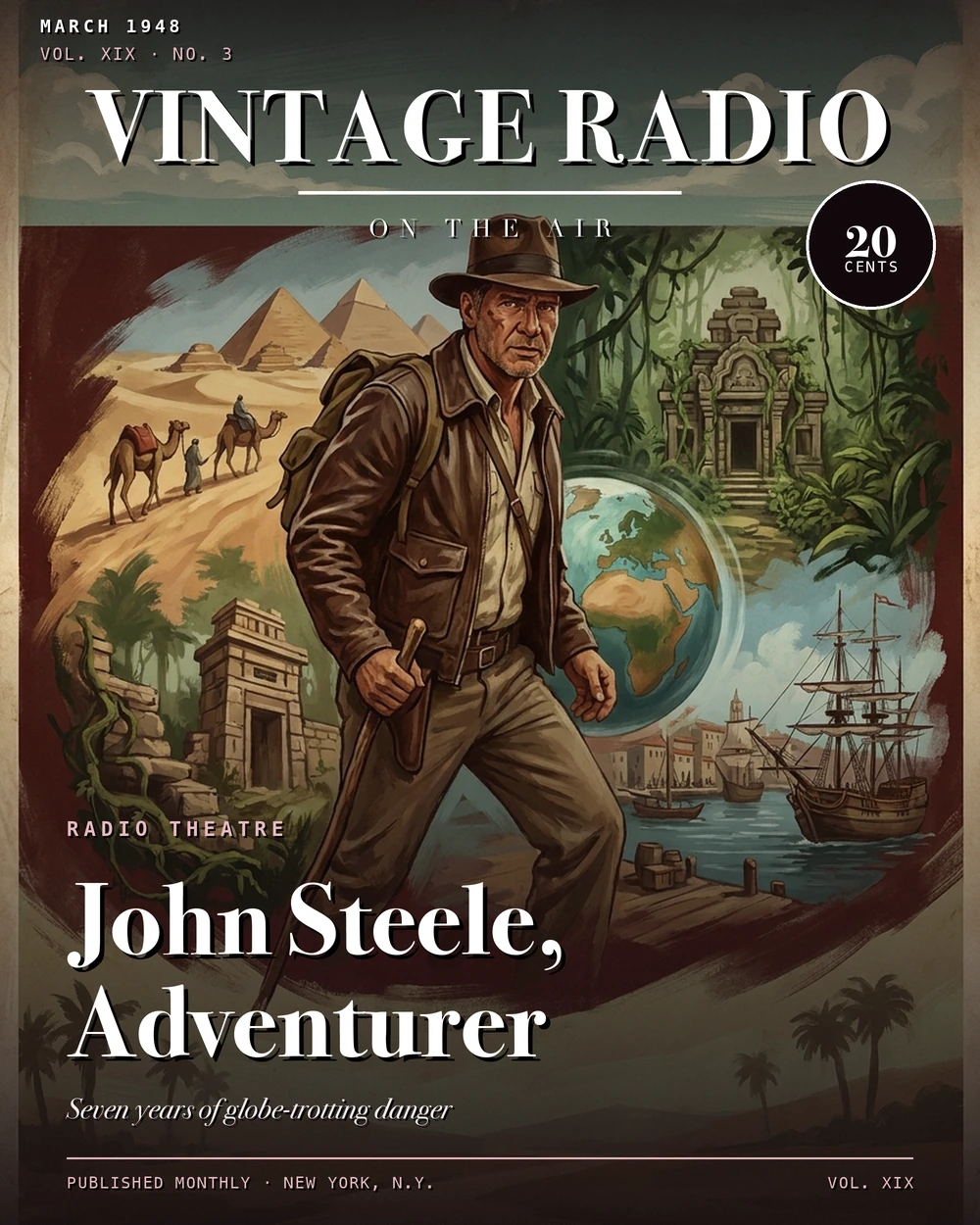
John Steele, Adventurer
The Setup
John Steele, Adventurer ran on Mutual from April 26, 1949, to July 16, 1956 — a seven-year stretch that adds up to more than 225 half-hour episodes by most estimates. It never became a household name the way Suspense or Escape did, but it delivered something consistent: competent, gritty adventure with a stark musical backdrop and a storytelling approach unusual enough to set it apart from the crowd.
The title character was a former World War II fighter pilot who had turned his skills into a one-man cargo airline, taking freight to wherever in the world someone needed it. That was the premise laid out in the pilot episode, "Cargo Unknown," broadcast July 12, 1949. In practice, the show sent Steele everywhere — jungles, deserts, high seas — and cast him in occupations as varied as country sheriff, special agent in Turkey, and ship's captain depending on where the story needed him. The whole thing read like the pulp action magazines of the era, particularly All-Story and Argosy.
How the Stories Were Told
One of the show's more distinctive choices was structural. Steele wasn't exactly the protagonist of his own series. Each episode was narrated by a friend of Steele's, and Steele himself appeared in a supporting or cameo role within that frame — the action centered on the people he encountered rather than on him directly. That gave the show room to range widely: episodes covered romantic comedy, high-seas adventure, sports, and mystery, sometimes in the same week. At the close of each one, Steele's voice delivered a sign-off: "A life of adventure is yours for the asking, but don't look for it; it may find you! Happy hunting!"
The music was a genuine part of the show's character. Sylvan Levin composed and provided the score in the early run; Doc Whipple took over later. Both contributed to the stark, atmospheric backdrop that gave the show its texture.
The Man Who Made It
Robert Monroe wrote, directed, and produced John Steele, Adventurer — and his biography turns out to be one of the more remarkable stories attached to any old-time radio program. Born October 30, 1915, Monroe came up through radio stations WHK in Cleveland and WLW in Cincinnati before moving to New York in 1939. He worked as Radio Production Manager at the advertising agency Donahue & Coe, then in 1953 formed RAM Enterprises, which at its peak was producing as many as 28 network radio programs monthly. John Steele was one of them; others included High Adventure, Nightmare, Thrill Seeker, Take a Number, and Meet Your Match. Monroe also served as Vice President and Board Member of the Mutual Broadcasting System for more than two years while producing the show.
Monroe was reportedly among the first radio producers to use prerecorded musical bridges systematically. Blocked from recording them under musician union rules, he took his audio equipment to Cuba and hired a local orchestra for six days of sessions. Ronald Russell's biography The Journey of Robert Monroe: From Out-of-Body Explorer to Consciousness Pioneer notes that during those sessions the musicians "played to an audience of one — a nephew of Cuba's dictator, Fulgencio Batista, who sat listening with a revolver by his side." Monroe left radio a wealthy man after 1956 and spent the rest of his life in consciousness research, eventually founding The Monroe Institute in 1974 and authoring the 1971 book Journeys Out of the Body, which popularized the term "out-of-body experience."
The Cast
Don Douglas played John Steele throughout the run. The supporting cast came from New York radio's working ranks — John Larkin, Bryna Raeburn, and Jack Edwards among them. Larkin, born in Oakland in 1912, stayed with the series for its entire seven-year run while simultaneously playing Perry Mason on CBS Radio and turning up in Dimension X and X Minus One on NBC. Additional players documented in a Radio Spirits commercial release of sixteen episodes include Ross Martin, Abby Lewis, Jim Boles, and Inge Adams, along with rare radio appearances by Eva Marie Saint and Howard Caine. Ted Mallie, known for his work on The Shadow and I Love a Mystery, announced the series. Elliot Drake directed; Monroe's role was writer and producer.
What Survives
The show originally debuted as part of Mutual's "Tuesday Night is Mystery Night on Mutual" programming block, and it was moved to different timeslots repeatedly over its run, which probably didn't help its profile. The estimate that the "Peepsight" episode of June 25, 1953, was the program's 165th show suggests a total production run of more than 225 episodes — of which only around 50 are currently known to survive. A certified set was issued in 2015, with a Program Guide written by Karl Schadow accompanying the Radio Spirits commercial release. Among the surviving titles are "Cargo Unknown," "Lighthouse Twelve," "Salvage," "Vampire," and "Shadow on the Snow," spanning the early 1949–1950 run and scattered later episodes through 1954.
One listener review described it as "a good, and rather underrated show" and suggested that fans of Escape would find many episodes equally compelling. That's probably the right frame for it: not a landmark series, but a professionally made, atmospherically produced adventure program that held its ground for seven years — and happened to be built by one of the stranger figures in American broadcasting history.